Your Shift Ended at 7 A.M. Your Body Didn't Get the Memo. It's Stuck Between Three Signals — And Nobody Told You About Two of Them.
Why overnight dispatchers get home exhausted but still wired — and why blackout curtains and melatonin gummies haven't fixed it.

There is a specific moment that happens to overnight dispatchers — usually somewhere between pulling into the driveway and the third time you check the clock.
The headset is off. The console is someone else's now. The blackout curtains are closed. Your body is heavy with twelve hours of it.
And your brain is still listening for the next tone.
You lie there. You replay a call. You check your phone "just once." It's 9:40. Then 10:15. When sleep finally comes, it's thin — and you're up again four hours later, wide awake for no reason you can name.
Most dispatchers who live this have already heard the standard advice: blackout curtains, no screens, cut the coffee, take a melatonin. Most have tried at least three of those.
And they're still lying there.
Not because the advice is wrong. Because it was written for people who go to bed at 11 p.m. after a normal day. Your problem isn't bedtime. It's the transition — and your body is getting three different signals while it tries to make it.
Here is what's actually happening.
The First Signal: Your Body Is Still on Duty
For twelve hours, your job was to respond. Every tone, every ring, every burst of radio traffic trained your system to stay switched on — and rewarded it for staying that way.
That state doesn't end when you badge out. Alertness built over a long, high-stakes shift takes time to settle, and nothing about the drive home tells your body it's allowed to.
Day workers get hours of buffer: a commute, dinner, a show, a slow slide toward bed. A lot of overnight dispatchers go from headset to pillow in under an hour.
This is not a toughness problem. The same wiring that makes you good at the console is what's keeping you up. It just doesn't come with a switch labeled "clock-out."
“The call ended. The shift ended. Your alert system never got the message.”
The Second Signal: The Sun Is Telling Your Brain It's Morning
Your body runs on an internal clock, and light is the main thing that sets it.
In darkness, your brain releases melatonin — the hormone that works as your body's "it's night" signal. Bright light, especially morning light, pushes that signal down.
Now think about your drive home. Sunrise through the windshield. Maybe a gas-station stop under bright lights. Every minute of it tells your internal clock the day is starting — right before you ask it to sleep.
So you're trying to sleep against two signals at once: an alert system still on duty, and a clock that thinks it's time to get up.
That's not a willpower problem. It's not a discipline problem. It's not something a sleep-tracking app will solve. It's two separate signals pointing the same direction — awake.
The Third Signal: The One No One Is Talking About
The first two explain why you're wired and why daytime sleep feels thin.
The third explains why nothing you've tried seems to stick.
There is no transition.
People on a normal schedule have dozens of small cues that tell the body the day is over: dinner, dimmer lights, the same show, the same routine, around the same time every night. The body learns those cues. They become a signal.
Your schedule breaks every one of them. Your bedtime moves. Your days off flip you back. Your "evening" is 8 a.m. on Tuesday and 11 p.m. on Saturday.
So your body never learns the signal — because there isn't one to learn.

“You may not control the schedule. You can control the signal that the shift is over.”
Why the Standard Fixes Don't Reach the Problem
Most fixes for post-shift sleep deal with one signal and ignore the other two.
Blackout curtains handle the light in the bedroom. They do nothing about the alert state you carried in, or the sunrise you drove through to get there.
Cutting caffeine sounds simple until it's 4 a.m. and you're on hour ten. For most dispatchers, dropping coffee isn't realistic — it's what makes the shift possible. A fix that only works if you change your whole job isn't a fix. (Worth knowing: caffeine can stay active for hours, so a late-shift cup may still be with you on the drive home. A set cutoff time helps — there's a worksheet for that below.)
Magnesium stacks work for some people. For others, they're one more bottle on the counter — or they just don't agree with them.
Melatonin gummies are where most people end up. And that's where the next problem starts.
The Dose Question: Why More Melatonin Isn't the Answer
There's one more layer, because it explains why so many dispatchers have already tried melatonin — and decided it isn't for them, or that it leaves them feeling heavy.
Turn over the melatonin bottle in your cabinet. Find the Supplement Facts panel on the back — not the marketing on the front. Look for the milligrams.
Melatonin is a timing signal. Your body makes it on its own, in small amounts, when it gets dark. More is not automatically better.
The dispatcher who woke up foggy after a 10 mg gummy usually decides melatonin "doesn't work" for them. What they actually wanted was simpler: to know exactly how much they were taking — and to use it as one part of a routine, not the whole plan.
What Actually Fits the Problem: A Signal, Not a Knockout
If the problem is a missing transition, the answer isn't a heavier sleep aid. It's a clear, repeatable signal — the same two steps, no matter what the clock says.
That's the idea behind the Shift-Down Sequence from Shift Down: a two-step, magnesium-free wind-down ritual built for people who work while everyone else sleeps.
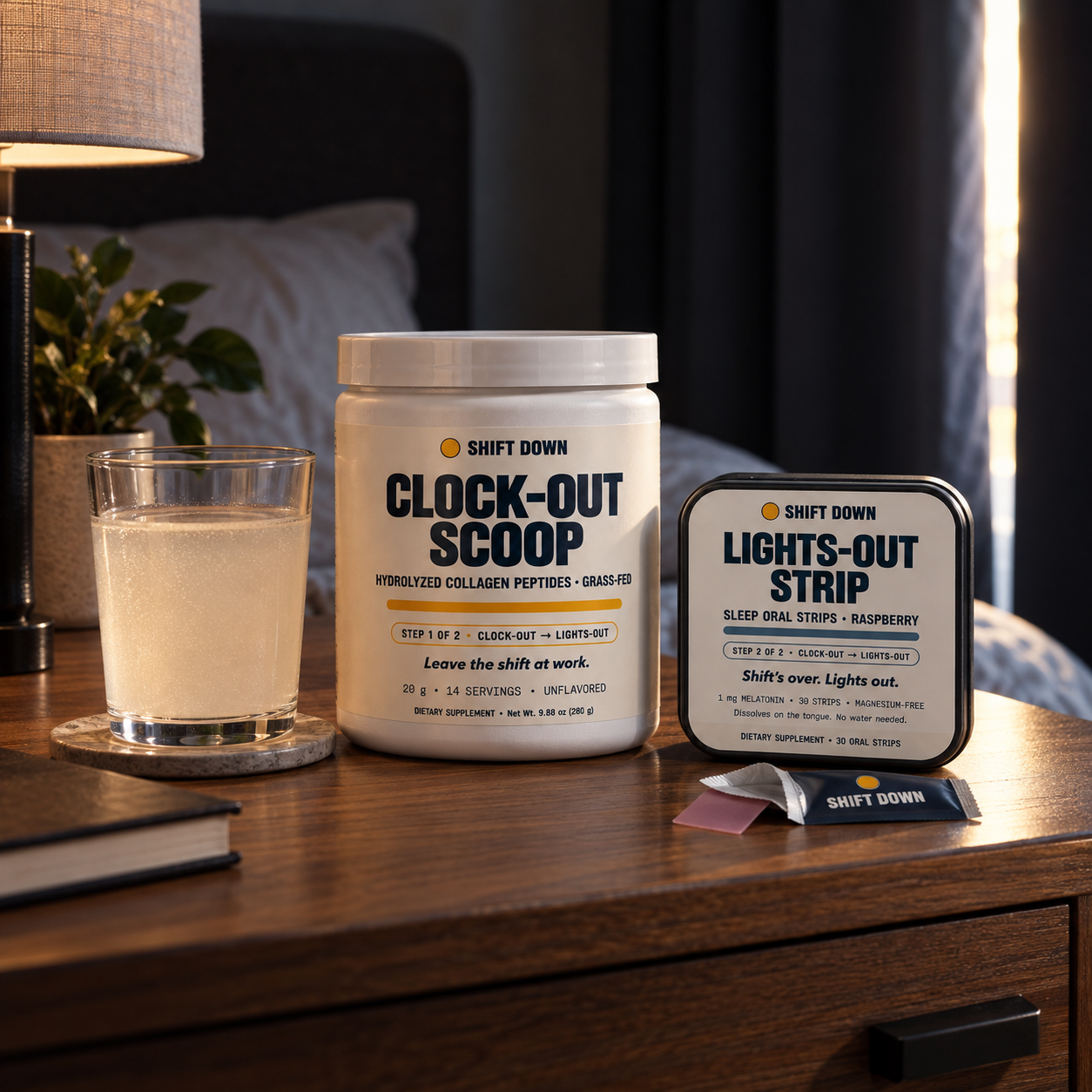
The Clock-Out Scoop
One scoop of unflavored collagen peptides (20 g) in cold water or whatever you drink. 18 g of protein after a long shift — and a deliberate first move that marks the line: duty's over.
The Lights-Out Strip
One raspberry strip on your tongue. It dissolves — no pill, no water. Each strip has 1 mg melatonin plus valerian, lavender, chamomile and hibiscus extracts.
Same two steps after a Tuesday overnight or a Saturday double. Your bedtime moves. Your wind-down signal doesn't have to.
What's Inside (Nothing Hidden)
Hydrolyzed bovine collagen peptides, unflavored. 18 g protein per scoop. Collagen naturally contains glycine, one of the amino acids it's built from.
The same hormone your body makes in darkness. 1 mg per strip, printed plainly on the label — not buried in a blend.
A root used in evening teas and nighttime routines for generations.
A classic ingredient in wind-down routines and bedtime teas.
One of the most familiar bedtime tea herbs there is.
A tart botanical that rounds out the raspberry flavor.
Magnesium works for some people. This is a different option for people who'd rather skip it — no supplemental magnesium, no five-bottle stack.
What It Won't Do
You deal with enough people overselling things. So here's the straight version.
It won't give you more hours. Nothing replaces sleep, and nothing turns four hours into eight. This makes the time you do have start with a clear routine.
It won't erase a hard call. If calls are following you into sleep night after night, that deserves real support — your doctor, your EAP, or your center's peer support team.
It's not for before duty. Melatonin can cause drowsiness. Don't use the strip before driving, before a shift, or when you could be called in.
“Nothing replaces sleep. But the hour before it shouldn't be an afterthought.”
Start With the 14-Night Shift-Down Starter
Two weeks is enough to find out whether a consistent two-step signal fits your rotation.
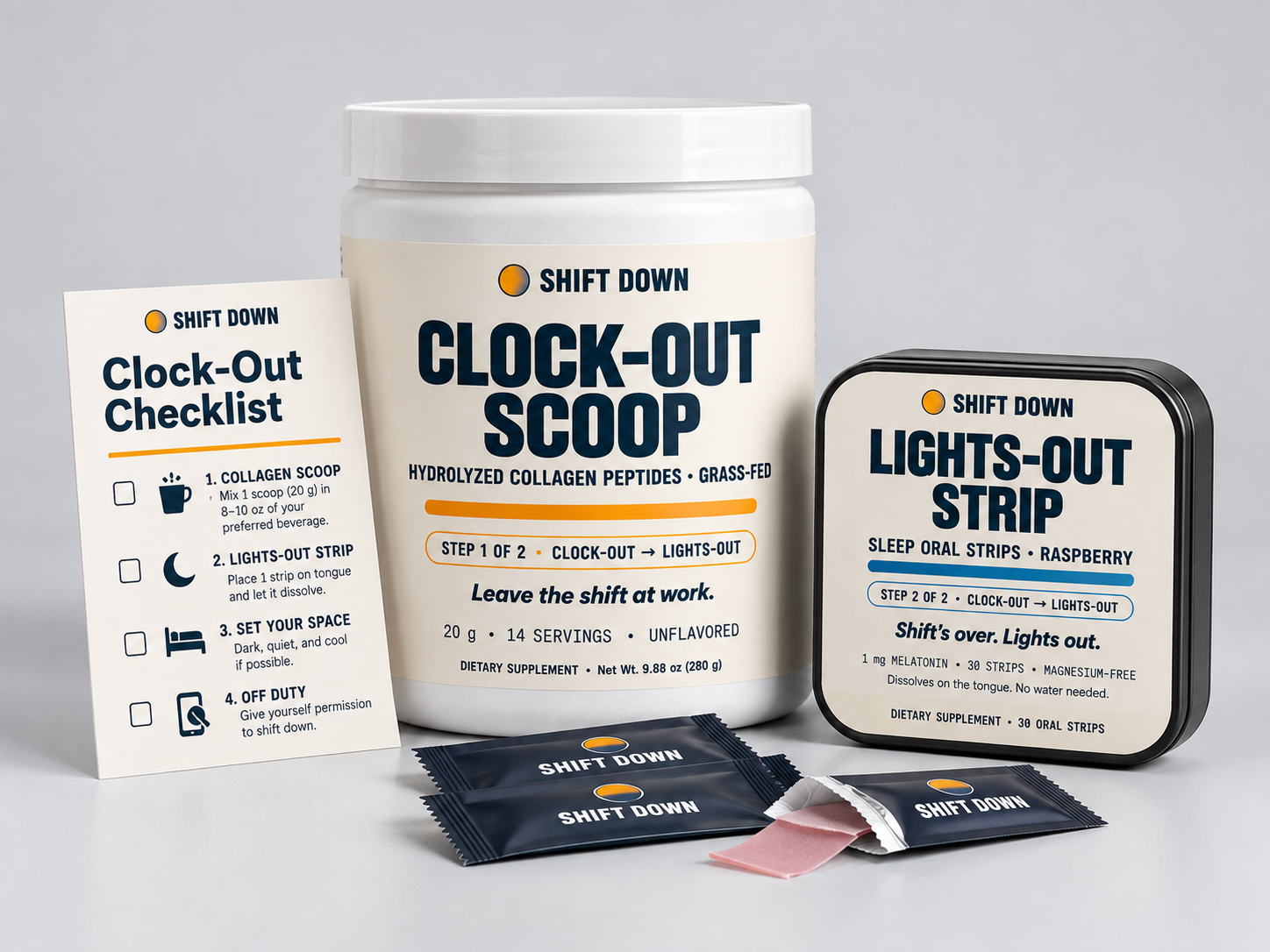
14-Night Shift-Down Starter
One scoop. One strip. Clock-out to lights-out.
- 1 × Collagen Peptides (14 scoops, 20 g each)
- 1 × Sleep Strips tin (30 strips, 1 mg melatonin each)
- = 14 full two-step nights, plus 16 extra strips for strip-only nights
- Free standard shipping
Price: $89.80 $67.98
Guarantee: We're so confident in the quality of our product that we offer a satisfaction guarantee. If you're not completely satisfied with your purchase, simply return the item within 30 days for a full refund.